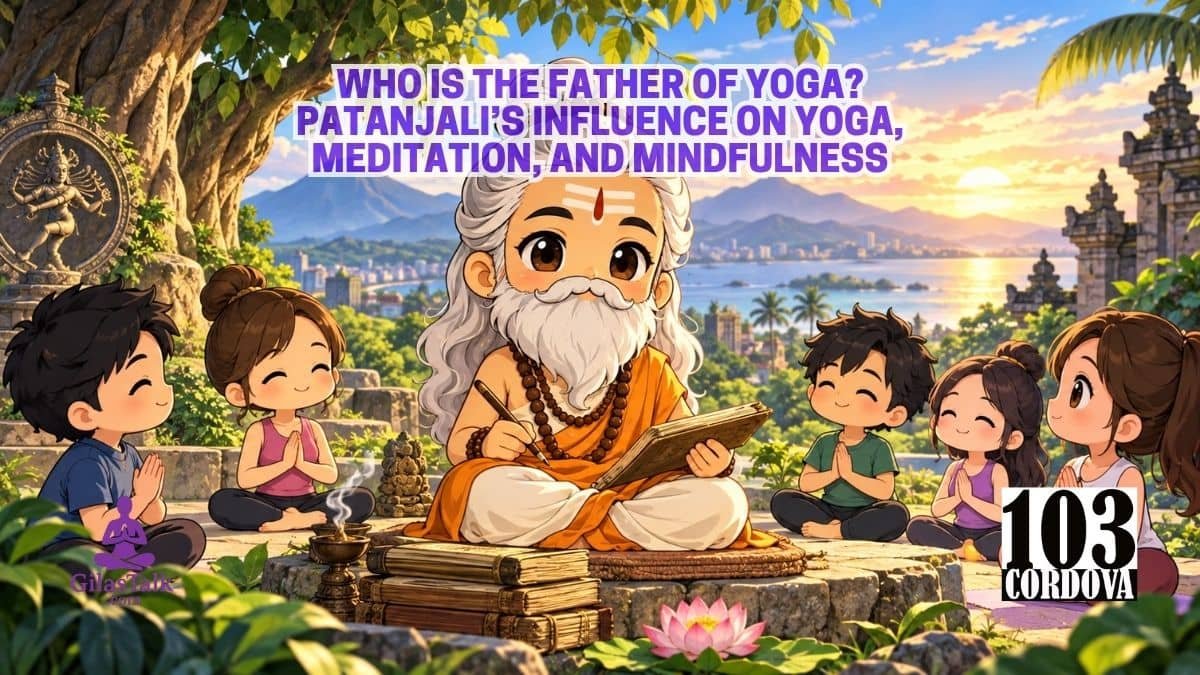
If you’ve ever wondered who the “Father of Yoga” is, the name you’ll most often hear is Patanjali, the ancient Indian sage traditionally associated with the Yoga Sutras.
But there’s an important distinction to make: Patanjali did not invent yoga. Yogic ideas and practices existed long before him. His major contribution was organizing earlier teachings into a systematic approach that became one of the most influential foundations of classical yoga.
The Yoga Sutras also show us that yoga involves much more than physical postures. Patanjali’s system includes ethical principles, posture, breath regulation, concentration, meditation, and ultimately liberation.
This broader view remains valuable today, whether you’re studying yoga philosophy, developing a meditation practice, or simply attending a yoga class here in the Philippines.
Let’s explore who Patanjali was, what he taught, and why his ideas continue to influence the way we understand yoga today.
Key Takeaways
- Patanjali is commonly called the Father of Yoga, although yoga existed long before him.
- He is traditionally associated with the Yoga Sutras, one of the most influential texts of classical yoga.
- Patanjali described an eight-limbed path of yoga that includes ethics, posture, breathing, sensory discipline, concentration, meditation, and samadhi.
- Physical posture, or asana, is only one of Patanjali’s eight limbs.
- Patanjali’s teachings place considerable emphasis on understanding and disciplining the mind.
- His teachings share certain similarities with modern mindfulness, but modern mindfulness should not be viewed as originating solely from Patanjali.
- Patanjali’s work continues to remind us that yoga can involve not just movement, but also awareness, ethical conduct, concentration, self-study, and meditation.
Who Is Patanjali, the Father of Yoga?
Patanjali is an ancient Indian sage traditionally credited with compiling the Yoga Sutras, one of the most important texts in the history and philosophy of yoga.
Exactly who Patanjali was and when he lived remain uncertain. Scholars have proposed different dates for the composition of the Yoga Sutras, and very little reliable biographical information about him survives.
What is clearer is that yoga existed before Patanjali.
Earlier Indian traditions already included meditation, ascetic disciplines, breath practices, and philosophical ideas that would become associated with yoga. Patanjali was therefore working within an existing tradition rather than starting yoga from the beginning.
So why is he often called the Father of Yoga?
A useful way to understand the title is to think of Patanjali as one of yoga’s great systematizers. The Yoga Sutras organized important yogic concepts into a structured philosophical and practical system that influenced generations of practitioners, teachers, commentators, and scholars.
His importance comes not from inventing yoga, but from helping give classical yoga one of its most enduring frameworks.
🧘 What are the Common Mistakes to Avoid in a Yoga Class for Beginners?
What Are the Yoga Sutras of Patanjali?
The Yoga Sutras are a collection of nearly 200 concise aphorisms, or sutras, dealing with yoga, the mind, meditation, spiritual practice, and liberation.
Different textual traditions count either 195 or 196 sutras, depending on how certain passages are divided.
A sutra is intentionally brief. Rather than offering long explanations, each statement condenses an idea that can be interpreted and expanded through teaching and commentary.
The Yoga Sutras are traditionally divided into four chapters, or padas:
Samadhi Pada
This chapter introduces the nature and purpose of yoga and explores concentration, mental activity, and meditative absorption.
Sadhana Pada
This chapter focuses on spiritual practice and includes Patanjali’s well-known description of the eight limbs of yoga.
Vibhuti Pada
This section explores advanced concentration and meditation and discusses extraordinary abilities traditionally associated with advanced yogic practice.
Kaivalya Pada
The final chapter deals with liberation and the nature of consciousness.
Together, these chapters show that classical yoga is concerned with much more than physical exercise. The primary emphasis is on understanding and transforming one’s relationship with the mind and, ultimately, attaining liberation.
🧘 Essential Tips on What to Wear to Yoga Class for Beginners
What Did Patanjali Mean by Yoga?
One of the most famous passages in the Yoga Sutras appears near the beginning:
Yogaś citta-vṛtti-nirodhaḥ — Yoga Sutra 1.2
A commonly encountered translation is:
“Yoga is the cessation of the fluctuations of the mind.”
Translations of this statement vary. Terms such as stilling, restraint, cessation, activities, modifications, or fluctuations may be used because Sanskrit concepts do not always correspond neatly to a single English word.
What is important is the emphasis Patanjali places on the activity of the mind.
Our attention can constantly move from one thought to another. We remember past events, anticipate the future, react emotionally, form judgments, and become distracted by what is happening around us.
Patanjali’s approach to yoga progressively trains attention and concentration, leading toward increasingly profound states of meditation.
So while physical postures may be the most visible part of yoga today, Patanjali’s definition reminds us that classical yoga is fundamentally concerned with the mind, consciousness, and liberation.
🧘 What is Kriya Yoga? How It Compares to Other Yoga Practices
What Are the Eight Limbs of Yoga?
One of Patanjali’s most influential teachings is Ashtanga, meaning the eight-limbed path of yoga.
The eight limbs help us see just how broad Patanjali’s concept of yoga really is.
1. Yama — Ethical Restraints
The yamas concern how we conduct ourselves in relation to other people and the world.
They traditionally include:
- Ahimsa — non-harming or non-violence
- Satya — truthfulness
- Asteya — non-stealing
- Brahmacharya — traditionally associated with sexual restraint and disciplined conduct
- Aparigraha — non-grasping or non-possessiveness
These principles place ethical behavior near the foundation of yogic practice.
2. Niyama — Personal Observances
The niyamas concern personal discipline and observance:
- Saucha — purity or cleanliness
- Santosha — contentment
- Tapas — disciplined effort or austerity
- Svadhyaya — study and self-study
- Ishvara Pranidhana — devotion or surrender to Ishvara
The yamas and niyamas together remind us that classical yoga isn’t simply something practiced during a class. It also concerns how a person lives and behaves.
3. Asana — Posture
Asana is the limb most familiar to many people who attend yoga classes today.
But Patanjali gives posture relatively little attention compared with modern forms of postural yoga. The Yoga Sutras do not provide the extensive catalogue of poses you might find in a modern yoga class.
Instead, posture forms one part of a much larger system.
This doesn’t diminish the value of contemporary asana practice. It simply reminds us that, historically, yoga encompasses much more than physical poses.
4. Pranayama — Breath Regulation
Pranayama involves the regulation and discipline of breathing.
Breathing practices remain an important part of many forms of yoga today and can help prepare practitioners for concentration and meditation.
Beginners may benefit from learning pranayama gradually under appropriate guidance, particularly before attempting more advanced breath-control techniques.
5. Pratyahara — Withdrawal of the Senses
Pratyahara refers to drawing attention away from external sensory objects.
Our attention is continually pulled toward sights, sounds, sensations, conversations, notifications, and countless other distractions.
Pratyahara represents a gradual movement inward and prepares the practitioner for deeper concentration.
6. Dharana — Concentration
Dharana means concentration.
Here, the practitioner learns to keep attention directed toward a chosen object or point of focus instead of constantly allowing the mind to wander.
7. Dhyana — Meditation
Dhyana refers to sustained meditation.
Concentration becomes increasingly continuous, with the mind remaining steadily engaged rather than repeatedly moving between distractions.
8. Samadhi — Meditative Absorption
Samadhi refers to profound states of meditative absorption.
It shouldn’t simply be understood as feeling calm or relaxed. Within Patanjali’s system, it represents increasingly advanced states of yogic meditation.
Together, dharana, dhyana, and samadhi demonstrate just how central concentration and meditation are to Patanjali’s understanding of yoga.
🧘 How to Choose Between Vinyasa Vs Yin Yoga for Your Fitness Goals
Are Yoga and Mindfulness the Same Thing?
Not exactly.
Modern mindfulness is commonly associated with intentionally bringing awareness to present experience, often with an attitude of observation and reduced judgment.
Patanjali’s teachings also place considerable importance on attention, concentration, meditation, and understanding mental activity.
Because of this, someone familiar with mindfulness may recognize similarities in Patanjali’s teachings.
However, Patanjali’s yoga and modern mindfulness should not be treated as the same practice.
Mindfulness has a complex history, with particularly important roots in Buddhist contemplative traditions. Contemporary mindfulness has also developed through interactions among Buddhist meditation, yoga, psychology, medicine, and other influences.
It is therefore more accurate to say that Patanjali’s yoga and modern mindfulness have areas of meaningful overlap, particularly in their attention to awareness, concentration, meditation, and mental activity.
🧘 Hot Yoga Vs Regular Yoga: Which One is Right for You?

What Is the Connection Between Yoga and MBSR?
Another term you may encounter in discussions of mindfulness is Mindfulness-Based Stress Reduction, or MBSR.
MBSR was developed by Jon Kabat-Zinn in the United States beginning in the late 1970s. It combines mindfulness meditation, body awareness, and yoga-based movement practices.
Yoga therefore has a genuine place within MBSR.
However, MBSR did not simply develop from Patanjali’s Yoga Sutras. Its development was influenced strongly by Buddhist meditation traditions as well as yoga and other contemplative practices.
Recognizing these different influences gives us a more accurate understanding of both traditions.
For someone practicing yoga today, the practical connection is simpler: movement, breathing, attention, and meditation can complement one another, even though they may come from traditions with different histories and goals.
🧘 Ashtanga Yoga Vs. Vinyasa Yoga: Key Differences and Benefits Explained
Why the Yamas and Niyamas Still Matter Today
It is easy to associate yoga mainly with poses, stretching, flexibility, and movement.
Patanjali gives us a broader perspective.
His eight-limbed system begins not with asana, but with principles concerning conduct, discipline, relationships, and personal practice.
Even when viewed outside their original religious and philosophical context, these principles can prompt useful reflection.
How do we treat the people around us?
Are we honest with ourselves and others?
Can we appreciate what we have without constantly wanting more?
Can we remain disciplined without becoming overly harsh with ourselves?
What habits deserve more of our attention?
These questions can be relevant whether you’re practicing yoga in India, the Philippines, or anywhere else.
They remind us that yoga can encourage reflection on how we live, not just what we’re able to do on a yoga mat.
🧘 Why Chair Yoga Training Is Essential for Office Workers
How Is Patanjali’s Yoga Different From Modern Yoga?
Walk into a yoga class in Metro Manila, Cebu, Davao, or elsewhere in the Philippines today, and you’ll probably encounter something quite different from the practices described in the Yoga Sutras.
A modern class may include sequences of physical poses, stretching, mobility work, breathing exercises, relaxation, and sometimes meditation.
Patanjali’s classical system places much greater emphasis on ethical discipline, concentration, meditation, consciousness, and liberation.
That doesn’t mean today’s physical forms of yoga are somehow illegitimate.
Yoga has continued to develop throughout history. Different traditions, including later Hatha and Tantric traditions, developed different practices and philosophical approaches. Modern postural yoga emerged through further historical and cross-cultural changes.
Understanding this helps us appreciate yoga more fully.
You can enjoy a modern yoga class for movement, flexibility, strength, breathing, relaxation, or personal practice while recognizing that the wider history and philosophy of yoga extend far beyond physical postures.
🧘 Why Somatic Yoga Training is a Game Changer for Stress Relief
Is Yoga a Religion?
This is a common question, particularly in a country such as the Philippines, where religion plays an important role in many people’s lives.
Yoga has deep historical connections with Indian religious and philosophical traditions. The Yoga Sutras belong to an ancient Indian philosophical context and include concepts that are part of that historical background.
However, people today practice yoga in many different ways.
Some approach it as a spiritual discipline. Others practice yoga primarily for physical activity, breathing, relaxation, meditation, or personal well-being.
Participating in a contemporary yoga class does not automatically require someone to adopt a particular religious belief.
At the same time, understanding yoga’s Indian origins and philosophical background allows us to approach the practice with greater knowledge and respect.
For Filipino practitioners, this means you can participate in yoga while making personal choices about how, or whether, the philosophical or spiritual aspects fit with your own beliefs and values.
🧘 Can Heated Vinyasa Yoga Help You Lose Weight Effectively?
Why Is Patanjali Still Important Today?
Why are we still discussing Patanjali after so many centuries?
Partly because the Yoga Sutras explore experiences that remain familiar:
Why is it difficult to concentrate?
Why does our attention wander?
How do our habits influence us?
How can we become more disciplined?
What happens when we observe our thoughts instead of immediately reacting to them?
Patanjali addressed these questions within a specific ancient Indian philosophical framework. His teachings should therefore not be reduced entirely to modern psychology or wellness advice.
Still, the experiences behind many of those questions remain recognizably human.
His work also gives today’s yoga practitioners an important reminder:
Yoga can encompass ethical living, posture, breathing, concentration, meditation, and self-study, not just physical movement.
That broader understanding is a significant part of Patanjali’s enduring legacy.
🧘 How to Learn Aerial Yoga Poses Names for a Better Practice
Conclusion: Why Is Patanjali Called the Father of Yoga?
Patanjali is commonly called the Father of Yoga, but the title needs some context.
He did not invent yoga. Yogic practices and ideas had already been developing in India before the Yoga Sutras were composed.
His great contribution was helping systematize an influential form of classical yoga, bringing together ethical principles, posture, breath regulation, concentration, meditation, and liberation within an organized framework.
His eight-limbed path reminds us that asana is an important part of yoga, but it isn’t the whole of yoga.
And while Patanjali shouldn’t be called the founder of modern mindfulness, his exploration of attention, concentration, meditation, and mental activity continues to have relevance for people interested in contemplative practices today.
Whether you practice yoga in India, the Philippines, or elsewhere, studying Patanjali can give you a broader appreciation of what yoga has meant throughout its long history.
Practice Yoga With Us in Marikina City
You don’t need to master ancient philosophy before attending your first yoga class.
For many of us, yoga begins much more simply: learning how to move with greater awareness, paying attention to our breathing, becoming familiar with different postures, and giving ourselves time to focus on our practice.
We offer yoga classes for different experience levels at 103 Cordova Tower, Marquinton Residences, Cirma Street, Sto. Niño, Marikina City.
Whether you’re completely new to yoga or already have experience, our classes provide a supportive environment where you can explore yoga at your own pace while working on movement, flexibility, strength, breathing, and body awareness.
For class schedules and inquiries, contact us at 0917-622-5780, message us through Facebook, or use our website’s contact form.
We’d be happy to help you choose a class suited to your experience level.
Frequently Asked Questions
1. Who is known as the Father of Yoga?
Patanjali is commonly known as the Father of Yoga because the Yoga Sutras systematized one of the most influential forms of classical yoga. However, yoga itself existed before Patanjali.
2. Did Patanjali invent yoga?
No. Yogic ideas, meditation practices, and ascetic traditions existed before Patanjali. His important contribution was organizing and systematizing yoga into an influential philosophical and practical framework.
3. What are the Yoga Sutras?
The Yoga Sutras of Patanjali are a collection of nearly 200 concise aphorisms dealing with yoga, mental activity, meditation, spiritual practice, and liberation.
4. Are there 195 or 196 Yoga Sutras?
Both numbers are used. Different editions and textual traditions count certain passages differently, so the Yoga Sutras are commonly described as containing either 195 or 196 sutras.
5. What are the eight limbs of yoga?
Patanjali’s eight limbs are:
- Yama — ethical restraints
- Niyama — personal observances
- Asana — posture
- Pranayama — breath regulation
- Pratyahara — withdrawal of the senses
- Dharana — concentration
- Dhyana — meditation
- Samadhi — meditative absorption
6. What is Patanjali’s definition of yoga?
Yoga Sutra 1.2 states Yogaś citta-vṛtti-nirodhaḥ.
One commonly used translation describes yoga as the cessation or stilling of the fluctuations of the mind. Exact translations vary because the Sanskrit terms can carry meanings that do not correspond perfectly to individual English words.
7. Is yoga mainly about physical poses?
Not according to Patanjali’s system. Asana, or posture, is only one of the eight limbs of yoga. Ethics, breathing, concentration, meditation, and other practices are also important parts of his system.
8. Is yoga the same as mindfulness?
No. Yoga and modern mindfulness have distinct histories and should not be treated as identical. However, they can overlap in practices involving attention, awareness, concentration, meditation, breathing, and observation of mental activity.
9. Did mindfulness originate with Patanjali?
No single figure can accurately be described as the sole origin of modern mindfulness. Patanjali’s teachings involve attention and meditation, but mindfulness also has important roots in Buddhist contemplative traditions and has undergone substantial development in modern psychology and healthcare.
10. Is MBSR based on Patanjali’s Yoga Sutras?
Not specifically. Mindfulness-Based Stress Reduction (MBSR) was developed by Jon Kabat-Zinn and combines mindfulness meditation, body awareness, and yoga. It has important Buddhist contemplative influences alongside yoga and other sources.
11. Can beginners practice yoga?
Yes. Many contemporary yoga classes offer beginner-friendly options and modifications.
If you’re new to yoga, tell your instructor about your experience level and any injury, pregnancy, health condition, mobility limitation, or other concern that may affect your practice. A qualified healthcare professional can also advise you if you’re uncertain whether a particular form of physical activity is appropriate for you.
12. Do I need to be flexible before joining a yoga class?
No. You don’t need to be flexible before beginning yoga.
Flexibility varies from person to person, and poses can often be modified according to individual ability. A beginner class should focus on learning safely rather than trying to force your body into a particular shape.
13. Can I practice yoga in the Philippines even if I follow a particular religion?
Yes. People in the Philippines and around the world practice yoga for many different reasons, including physical activity, breathing, relaxation, meditation, personal development, or spiritual practice.
Yoga has historical roots in Indian religious and philosophical traditions, but participating in a contemporary yoga class does not automatically require adopting a particular religious belief. You can decide how the philosophical or spiritual aspects of yoga fit with your own beliefs and values.
Content Disclaimer
This article is provided for general educational and informational purposes only. It offers a simplified introduction to Patanjali, yoga philosophy, meditation, mindfulness, and the historical development of yoga.
Yoga has a long and complex history encompassing numerous traditions, schools, texts, practices, translations, and scholarly interpretations. Some interpretations may differ from those presented here.
Information about yoga, mindfulness, breathing, meditation, physical activity, stress, or well-being should not be considered medical, psychological, or other professional healthcare advice. Yoga and meditation should not be used as substitutes for appropriate medical or mental healthcare.
Individual abilities, health conditions, and physical limitations vary. If you have an injury, chronic medical condition, cardiovascular or respiratory condition, are pregnant or postpartum, have recently undergone surgery, or have other concerns about exercising safely, consider consulting an appropriate healthcare professional before beginning or substantially changing your physical practice.
During a yoga class, let your instructor know about relevant limitations or concerns and avoid forcing yourself into a posture or breathing practice that causes pain, dizziness, unusual shortness of breath, or significant discomfort.